
Introduction

Introduction
The Japanese-Language Proficiency Test (JLPT) has been offered by the Japan Foundation and Japan Educational Exchanges and Services (formerly Association of International Education, Japan) since 1984 as a reliable means of evaluating and certifying the Japanese proficiency of non-native speakers.
At the beginning, there were approximately 7,000 examinees worldwide, but now it has become the largest-scale Japanese-language test in the world.
Development and International Role of the JLPT
Over time, test applicants have become more diverse, and use of JLPT results has expanded from skill measurement to include employment screening and evaluation for promotions and pay raises as well as use as a form of qualification.
Many outstanding suggestions for improvement were also submitted by a wide variety of individuals around the world.
Since 2009, the test has been offered twice a year: in July and December.
To ensure the continuing relevancy and accuracy of the JLPT, the Japan Foundation and Japan Educational Exchanges and Services introduced a revised version of the test in 2010.
This new test takes full advantage of the most advanced research in Japanese pedagogy and testing theory, and reflects the vast wealth of data accumulated since the original JLPT was launched over 25 years ago.
Certificate Issuance
“Japanese-Language Proficiency Test Certificate of Result and Scores” is issued for the purpose of admission to advanced education or finding employment. This certificate contains fail/pass results and scores for each scoring section. It can be used as official proof for schools and companies.
Four Key Characteristics
1. Measures communicative competence required to perform tasks
The JLPT places importance not only on (1) knowledge of Japanese-language vocabulary and grammar but also on the (2) ability to use the knowledge in actual communication. In order to perform various "everyday tasks" that require language, not only language knowledge but also the ability to actually use it are necessary. Therefore, the JLPT measures comprehensive Japanese-language communicative competence through three elements: "Language Knowledge" to measure (1), and "Reading" and "Listening" to measure (2).
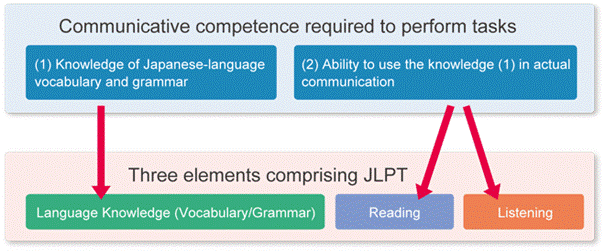
Due to the large scale of testing, answers will be machine-scored. Note that the JLPT does not include sections to measure speaking or writing proficiency directly.
2. Select a suitable level from among five levels
The JLPT is offered in five levels (N1, N2, N3, N4, N5). In order to measure Japanese-language proficiency as thoroughly as possible, test items are designed for each level. N4 and N5 measure understanding of basic Japanese that is mainly learned in the classroom. N1 and N2 measure understanding of Japanese used in a broad range of actual everyday scenes. N3 bridges the gap between N4/N5 and N1/N2.
See "N1-N5: Summary of linguistic competence required for each level."
3. More accurately measures Japanese-language proficiency with scaled scores
Despite the best attempts to assure consistency, it is inevitable that the level of difficulty of the test will differ slightly from session to session. Using "raw scores" (based on the number of correct answers) could result in different test scores for individuals with the same ability, depending on the difficulty of tests. Instead of raw scores, the JLPT has adopted "scaled scores." Scaled scores are based on the equalization method and allow measurement on the same scale regardless of time the test is taken. Scaled scores enable the JLPT to more accurately and fairly indicate Japanese-language ability at the time of testing.
See the more detailed explanation about scaled scores(PDF/71KB)
4. "JLPT Can-do Self-Evaluation List" is offered
Test scores and pass/fail results alone do not clarify what students can do in Japanese in real life. For this reason, the JLPT offers "JLPT Can-do Self-Evaluation List" as a reference to interpret test results. A question survey regarding "what activities are considered possible in Japanese" was conducted with approximately 65,000 examinees of the 2010 and 2011 JLPT. The results were analyzed and the list was prepared. The list can be used by examinees and others as a reference to get an idea of "what successful examinees of a particular level can do in Japanese."
For more details on "JLPT Can-do Self-Evaluation List," please check here.
N1-N5: Summary of Linguistic Competence Required for Each Level
The JLPT has five levels: N1, N2, N3, N4 and N5. The easiest level is N5 and the most difficult level is N1.

N4 and N5 measure the level of understanding of basic Japanese mainly learned in class. N1 and N2 measure the level of understanding of Japanese used in a broad range of scenes in actual everyday life. N3 is a bridging level between N1/N2 and N4/N5.
Linguistic competence required for the JLPT is expressed in terms of language activities, such as Reading and Listening, as shown in the table below. While not noted in the table, Language Knowledge, such as Vocabulary and Grammar, is also required for successful execution of these activities.
| Level | Total Score | Passing Score | Language Knowledge (Vocabulary/Grammar) | Reading | Listening |
|---|---|---|---|---|---|
| N1 | 0–180 | Overall passing score: 100 | 0–60 / section passing score: 19 | 0–60 / 19 | 0–60 / 19 |
| N2 | 0–180 | 90 | 0–60 / 19 | 0–60 / 19 | 0–60 / 19 |
| N3 | 0–180 | 95 | 0–60 / 19 | 0–60 / 19 | 0–60 / 19 |
| Level | Total Score | Passing Score | Language Knowledge (Vocabulary/Grammar) · Reading | Listening |
|---|---|---|---|---|
| N4 | 0–180 | Overall passing score: 90 | 0–120 / section passing score: 38 | 0–60 / 19 |
| N5 | 0–180 | 80 | 0–120 / 38 | 0–60 / 19 |